


PIK-Element: implementation of 1C:ERP Enterprise Management
Client company
PIK-Element (PIK-Module)
Industry
assembly-line production (automotive and more),construction
About the company
Headcount: 3,000
Base solution
1C:ERP Enterprise Management
Productivity up 4x, downtime down 5x
About the company
PIK-Element (PIK-Module) is a subsidiary of the PIK Group construction company. The company manufactures turnkey bathroom pods for installation in buildings under construction. It is a full-cycle assembly-line (conveyor) operation. Finished modules roll off the lines of two shops: a bathroom complete with tiles, all plumbing fixtures, utilities, and so on.
PIK-Element was essentially a startup for PIK, so the company faced the typical problems every young company goes through. PIK Group has a mature IT culture, well-built processes, and an agile approach. Lean manufacturing practices are actively applied in production. Open issues were discussed and resolved at weekly meetings, so the plant’s growth and the parallel automation never got stuck.

Situation before the project
The company decided to implement 1C:ERP and hired a 1C programmer for the job. However, one person cannot be an analyst, an architect, and a developer all at once. A project is not just data entry. It involves modeling, building processes, training staff, and much more.
At the start of the project, the company could not file its statutory reports and had no VAT calculation. By the end of the year, not a single report had been filed. The situation was critical.
Before that, accounting was kept in 1C:Accounting 8, which is not designed for manufacturing, especially for something as complex as assembly-line production of bathroom pods.
Project objectives
- Automate all departments within ERP. Have all departments enter documents promptly so that management can get management reports quickly, almost in real time. The legal entity had been set up less than a year earlier, no reports had been filed yet, and not a single month had been closed in the 1C database.
- See full cost in real time. Before the project, all of this was done manually in Excel.
- Reduce paperwork and free up employee time. During the project, output grew 7x in 1 year, while the number of office staff DID NOT INCREASE. The same people handled a 7x larger document flow thanks to process optimization and automation.
- And the strategic goal, which we learned about later: support the company’s rapid growth. At the start of the project, the headcount was 1,000; by the end, it was 3,000, with two assembly lines.
We had to get up to speed quickly and go live.
Methodology
We went with an agile methodology from the start. This was one of the first projects where the client kept pace with us methodologically, so we managed to launch 1C:ERP within a year, which is very fast for such complex manufacturing.
Of course, new tasks came up along the way. But tasks were never simply dumped on us with demands for immediate results. Every week we held meetings with the client, prioritized tasks, and decided what to do first and what to put off until later. The company’s senior management helped us a great deal here: they were involved in the process and provided information on time. Testing and acceptance of work took place practically the same day. There were no problems with signing acceptance certificates or with payment.
Thanks to the chosen methodology, the project had no particular difficulties. Of course, we argued, and not everyone always agreed with the changes. Employees used to the old ways of working found it hard. But every week we discussed all issues, problems, and conflicts, so instead of snowballing, they were resolved promptly.
What was done
- We immediately migrated opening balances, set up catalogs, and put the master data in order. We built a strong team of analysts and developers and provided methodological support to help the accounting department file its reports on time.
- Once operational accounting was up and running, we moved on to automating other departments: logistics, warehouse management, production planning, and budgeting. The challenge was that the plant is located in Moscow, so the warehouse is very small while turnover is high. Logistics had to be fine-tuned to keep warehouse stock to a minimum without delaying issues to production. An exact schedule of material deliveries and removals was needed, because several trucks at once simply would not fit. We introduced barcoding and mobile data collection terminals in the warehouses.
- With the fire now put out, management could see the real cost, and reports to regulators were filed from the 1C database as quickly as from the old one. We then moved on to automating planning and operation-level dispatching in production
- We set up seamless integration with the engineering documentation system used across PIK Group.
- We integrated with the electronic document management system. This eliminated double data entry across systems. All documents for receiving materials, issuing them to production, and so on are now generated in ERP, with much less paperwork and running around.
- We developed workstations for the production manager, the foreman, and assembly-line workers, and launched full operation-level dispatching. Tablets were installed on the shop floor so that each crew could see what to do and in what sequence, along with the plan for the whole day. When workers finished their job, they pressed a button, and once all the “buttons” were pressed, the system knew the line could move on. There were about 30 crews, each performing only its own operation on the bathroom pod at its own station.
- We reduced assembly-line downtime. When the line breaks down, every 5 minutes of downtime at a large plant means a missed plan that cannot be made up, and therefore lost money. After automation, since the repair technician could see on the tablet exactly where the failure had occurred, they were on site in less than a minute (previously 5–10 minutes).
Results
After a year of work, we achieved all the original goals, and even the tasks and goals that emerged along the way. And there were many of them, as the company was growing several-fold every quarter.
We achieved the most complete automation possible: all primary documents entered into the ERP system at the source, cost calculation, dispatching, and automated workstations. This made production more manageable and made it possible to significantly reduce costs and improve the company’s profitability.
Dispatching made it possible to manage assembly-line loading and plan material requirements. Warehouse stock was reduced. The logistics department was automated. In other words, everything that could have hindered the company’s rapid growth was thoroughly automated.
As a result, the company grew 4–5x: before the project, it produced 20–30 pods per day; by the end of the project, up to 130 pods per day. The company never had to stop or slow down because automation could not handle something.
Thanks to automation, the company did not need to hire additional administrative staff for accounting, budgeting, or planning. With production growing this fast, that is also an achievement and a major saving.
We integrated electronic document interchange (EDI) via Kontur.Diadoc, so all document exchange with counterparties now ran through ERP. No extra exports or printing.
In fact, there were very few customizations, despite the complexity of the production. We used standard ERP documents. In addition, we developed workstations that gave an interactive view of the production process.
Thanks to the project, automation reached not only managers but also every shop and every worker.
This is an outstanding result, given the project’s tight timeline.
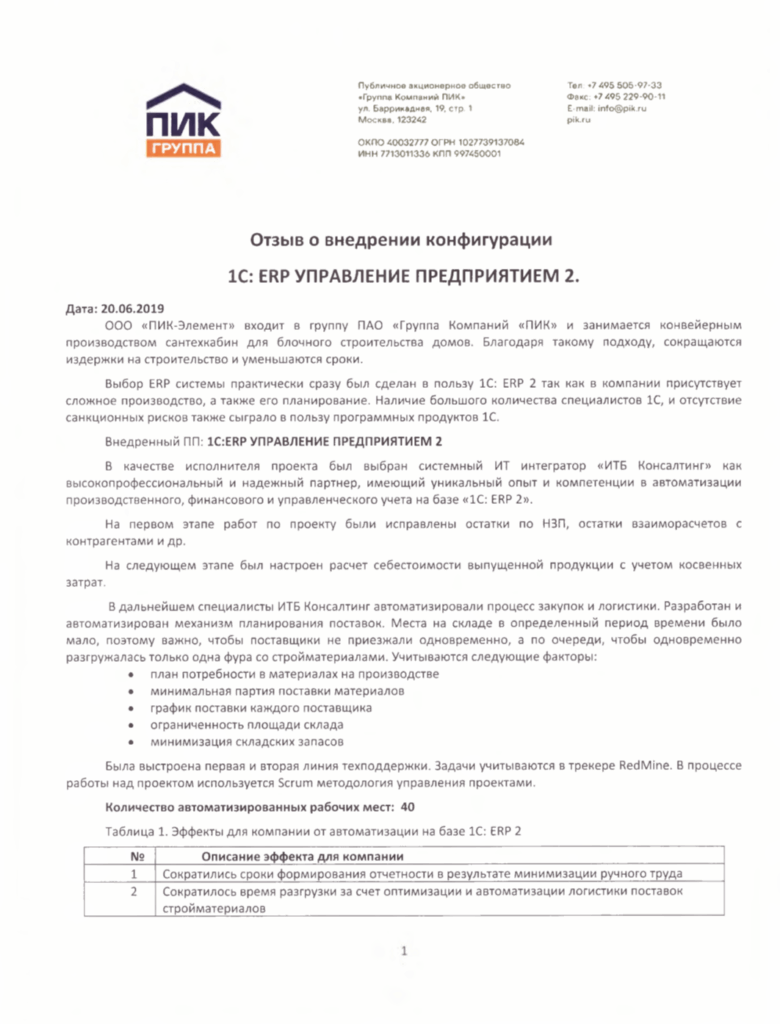
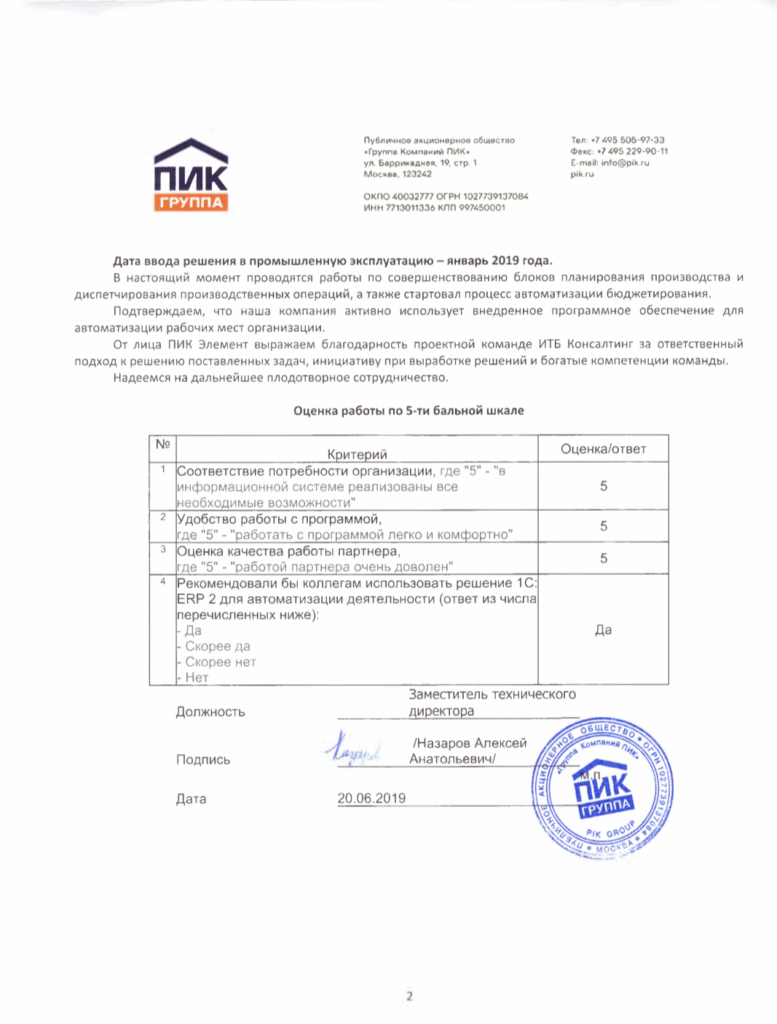
Client testimonial on the 1C:ERP implementation
Our recommendations
- Don’t be afraid to implement 1C’s flagship solutions: 1C:ERP and 1C:ERP Holding Management (1C:ERP.UH).
- Don’t assume the out-of-the-box software will fully fit your needs and won’t require customization. Our experts make maximum use of built-in functionality, which is the key to savings both at project launch and throughout the life of the system.
- Use agile approaches: the world is very dynamic and everything changes quickly, including legislation, your processes, and the external environment.
- Don’t write massive technical specifications or hide behind paperwork; instead, learn to manage the project competently and make the most of the agile philosophy.
- And most importantly: go to professionals from the start. Redoing the work takes longer and costs more.
Official testimonials and a detailed project description with technical details on the official 1C Company website – https://solutions.1c.ru/projects/994053/